
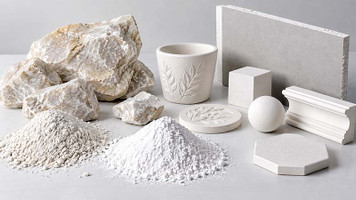
Gypsum vs Plaster of Paris: What Is the Real Difference?
Posted by Bawantha Perera on 5th Aug 2026
A Short History
Gypsum has been used for thousands of years in building, decoration & sculpture. Ancient people used gypsum plaster for walls, ornaments & artistic work.
The name "Plaster of Paris" became popular because large gypsum deposits near Paris were used to make fast-setting plaster. Over time, POP became a common name for quick setting gypsum plaster. A useful historical reference is the Museum of Fine Arts Boston conservation database.
Today, gypsum-based products are used in construction, art, craft, dentistry, ceramics, mould making, ceiling decoration and gypsum board manufacturing.
Buy Gypsum (Casting Grade) / Plaster of Paris
Gypsum vs Plaster of Paris
In Sri Lanka, the words gypsum and Plaster of Paris are often used as if they describe exactly the same material. They are closely related, but the terms can refer to different chemical forms and products.
The main difference is in the chemical form, processing method & how the material behaves when mixed with water.
To understand this clearly, we need to look at three common names:
- Pure gypsum
- Casting grade gypsum plaster
- Plaster of Paris, also called POP
What Is Pure Gypsum?
Pure gypsum is a natural mineral. When gypsum stone is only ground into powder, it remains mostly CaSO₄·2H₂O, called calcium sulfate dihydrate. The "2H₂O" means gypsum already contains water inside its crystal structure. This is chemically part of the mineral, not ordinary wetness.
Pure gypsum is used as a raw material for:
- Making Plaster of Paris
- Making gypsum plaster (casting grade)
- Gypsum boards and sheets
- Cement industry
- Soil conditioning
- Fillers in some products
Important point: pure gypsum powder does not set or get harder like casting grade gypsum or POP because it is already fully hydrated.
What Is Casting Grade Gypsum Plaster?
Casting grade gypsum plaster is a processed gypsum product made for casting, gypsum sheets, decoration and similar uses.
It is not just raw ground gypsum stone.
Casting gypsum plaster is often made from:
- Alpha hemihydrate
- Or an alpha and beta hemihydrate blend
- Sometimes with small additives to control setting time, flow, strength and working properties
The chemical base is usually: CaSO₄·½H₂O. This is calcium sulfate hemihydrate.
The “½H₂O” means part of the water has been removed by heating. Because of this, the powder can react with water and harden again. The heating process is called "calcination".
Casting grade gypsum plaster is usually made to give:
- Better strength
- Smoother surface finish
- Better detail in silicone moulds
- Lower water demand
- Less porosity than common POP
- Longer or more controlled setting time
This is why some casting gypsum plaster feels harder and denser than ordinary Plaster of Paris.
What Is Plaster of Paris?
Plaster of Paris, commonly called POP, is also made from pure gypsum.
Its usual chemical form is: CaSO₄·½H₂O. Most common POP is beta hemihydrate.
POP is made by "calcination", where gypsum is heated to remove part of its chemically bonded water.
When POP is mixed with water, it changes back into gypsum crystals: CaSO₄·½H₂O + water = CaSO₄·2H₂O + Heat
This reaction creates gypsum crystals. These crystals lock together and make the material hard.
POP is usually:
- Fast setting
- Pure white
- Light in weight
- More porous
- Easy to sand
- Good for general craft work
- Good for quick moulding and decorative work
How These Products Are Made
The process starts with natural gypsum stone.
1. Gypsum Stone Is Mined
Natural gypsum is taken from the earth as stone or rock.
2. The Stone Is Crushed and Ground
The gypsum stone is crushed into smaller pieces and then ground into powder.
At this stage, it is still mainly: CaSO₄·2H₂O
This is pure gypsum or ground gypsum.
3. Different Processing Gives Casting Gypsum or POP
Gypsum plaster changes depending on how the gypsum is heated and under what conditions the water is removed.
When natural gypsum stone, CaSO₄·2H₂O, is heated, part of its water is removed. This changes it into calcium sulfate hemihydrate: CaSO₄·½H₂O
But hemihydrate can be made in two main forms:
- Beta hemihydrate
- Alpha hemihydrate
Both come from gypsum, but they are made in different ways and behave differently.
Beta Hemihydrate: Beta hemihydrate is usually made by heating ground gypsum in normal dry heat, such as in a kettle, kiln or open calcining system.
This is the common material used to make Plaster of Paris, or POP.
Because it is made in dry heat, the particles are usually more irregular and porous. This means beta hemihydrate normally needs more water to make a workable paste. Because more water is used, the final casting is usually:
- Lighter
- More porous
- Easier to sand
- Faster setting
- Lower in strength compared to alpha plaster
This is why common POP is good for general craft, school projects, decorative moulding and quick casting work.
Alpha Hemihydrate: Alpha hemihydrate is made under more controlled conditions, usually with steam pressure or wet processing.
Because of this controlled process, the particles are denser, smoother and more regular in shape. Alpha hemihydrate needs less water to make a workable mix. Because less water is used, the final casting becomes:
- Denser, compact and well-formed
- Stronger, Harder & Less porous
- Better for fine details
This is why alpha plaster is used for stronger casting plasters, dental stone, ceramic moulds, and high quality mould casting.
Alpha and Beta Blends
Most gypsum plaster products are made by blending alpha and beta hemihydrate. This is done to balance performance and cost.
Alpha hemihydrate gives better strength, density and surface finish. Beta hemihydrate helps keep the product easier to mix, more affordable and suitable for general use.
A blended gypsum plaster can give:
- Better strength than normal POP
- Better surface finish
- More controlled setting time
- Good flow into moulds
- More practical cost than pure alpha plaster
This is why casting grade gypsum plaster is often not the same as ordinary POP. Both may come from gypsum, but the processing method and final performance can be different.
Conclusion
POP is made from gypsum, but gypsum and POP are not the same form.
Pure gypsum is CaSO₄·2H₂O. It is the natural mineral and is already fully hydrated.
Plaster of Paris is usually CaSO₄·½H₂O, mainly beta hemihydrate. It is made by heating gypsum and removing part of its water, so it can set again when mixed with water.
Casting grade gypsum plaster is also a processed gypsum product. It is often alpha hemihydrate or an alpha-beta blend, made for stronger, smoother and more controlled casting work.
So, when someone says “gypsum and POP are the same,” the better answer is:
POP is made from gypsum, but pure gypsum, casting gypsum plaster and Plaster of Paris are not the same in processing, performance and use.